We may experience hour changes due to Texas weather We may experience hour changes due to Texas weather We may experience hour changes due to Texas weather We may experience hour changes due to Texas weather

Spoof Calls, Scam Texts, and Fake Emails: Know the Signs

You have probably seen it in the news lately: an unsuspecting person gets a call, text, or email from a number/address that looks like their financial institution. They are told a large purchase has been made from their account and that in order to address the fraud, they need to give personal information, move money between accounts or even out of their account, and so on. This is a disturbing trend and can leave people with significant financial losses and little recourse to reclaim their funds.

The good news? Knowing the signs, stopping to take a breath and think, and confirming with whom you are speaking, can all help you avoid falling for these scams. Check out the tips below to be better prepared and protect yourself.

Knowing the Signs

  • Requests for Personal Information: Soarion CU will NEVER call, text, or email you to specifically ask for personal information such as one-time passcodes, passwords, usernames, Tax ID, Social Security Number, etc. We value your privacy.
  • Unfamiliar number: It helps to take a moment to check the actual number and/or email address the message is coming from, not just the display name. If the number looks unfamiliar, or the email has a different domain than “@soarion.org,” it’s best to be cautious and not engage with the message.
  • Sense of urgency: Most scams rely on your sense of urgency in the face of potential fraud and losses. Remember: It’s okay to take a moment to verify information. 

What You Can Do

  • Verify: If someone is claiming there is fraud on your account, take a moment to check your account transactions to verify the information.
  • Contact: If there is suspicious activity, hang up and call us back at one of our confirmed numbers. You can find them here.
  • Take a breath: If you are ever on a call that we have initiated, and you wish to verify that you are speaking to Soarion CU, feel free to end the call and call us back at one of our confirmed numbers. Our employees respect your privacy and comfort, and will never protest to you taking extra verification steps. You may ask for the original Member Engagement Advisor you spoke with if you like. 

What you Can Expect from Soarion CU

  • Our team will NEVER ask you to move funds between accounts or out of your account.
  • We will ask questions to determine if transactions are legitimate. This will NEVER require you to divulge sensitive private information.
  • If there is confirmed fraud on the account, we will put a hold on it to protect your funds, and begin the account recovery process.
  • The recovery process may include cancelling and reissuing cards, or, in some cases, closing out the account and establishing a new one.

Being aware of the facts above can help you avoid financial losses and exposure of your sensitive and private information. With diligence and a clear head, you can rest assured in being protected from fraud. If you ever have any questions, please do not hesitate to reach out to us  at (210) 673-5610 or visit one of our financial centers

Elder Abuse Awareness Day

Did you know that June 15th is World Elder Abuse Awareness Day? At Soarion, we are committed to raising awareness about elder abuse, especially the often-overlooked threat of financial exploitation. Every older adult deserves to live with dignity, respect, and safety — and we all have a role to play in making that happen.

What Is Elder Abuse?

Elder abuse is a growing global concern. It involves intentional harm or neglect by someone in a position of trust, and it can include:

  • Physical abuse
  • Emotional or psychological abuse
  • Sexual abuse
  • Neglect
  • Financial exploitation (the most common form)

1 in 10 adults aged 65+ in the U.S. experiences some form of abuse each year (U.S. Department of Justice).

Why Awareness Matters

Many older adults can’t speak up — due to illness, fear, or dependence on their abusers. They need advocates to notice the signs and take action. Recognizing abuse is the first step in stopping it.

How You Can Help

  • Check in regularly on elderly loved ones or neighbors
  • Be alert during life changes like retirement, illness, or the loss of a spouse
  • Stay connected and keep them engaged in their community
  • Speak up if something seems wrong

At Soarion, We:

  • Promote education and awareness
  • Provide prevention resources
  • Intervene on behalf of victims

Let’s work together to protect our aging population. No one should suffer in silence.

What is Mystery Shopping?

🕵️‍♀️💬 What is Mystery Shopping?

It’s when retailers or restaurants hire people (aka mystery shoppers) to test their products or services and report back on the experience. Think of it as getting paid to shop or dine out! 🛍️🍽️

Mystery shoppers usually pay upfront, then get reimbursed — sometimes with a little extra 💵. It’s a cool way to earn on the side, but 🚨 beware of scams:

❌ Don’t pay to get a job — legit mystery shopping gigs won’t charge you

❌ Don’t pay for job lists — that info is free

❌ Don’t wire money or deposit sketchy checks

❌ If it sounds too good to be true (like quitting your job for mystery shopping), it probably is!

✅ Always research the company & talk to someone you trust before signing up.

Stay smart, stay curious, and shop safe! 🧠💡

Watch Out for Job Scams

Looking for a new job? Make sure you’re protecting yourself every step of the way!

It can be tough to spot a scam, but knowing the warning signs can help you avoid falling victim.

Here are some common red flags to look out for:

  • Fake Job Listings: Listings that ask you to pay a fee to apply.
  • Suspicious Emails: Scammers pretending to be recruiters, asking for sensitive info like your bank details.
  • Weird Interviews: Interviewing via random messaging apps or being asked for personal info up front.
  • Work From Home Scams: Watch out for offers to buy expensive equipment with the promise of a refund that never comes.

Warning Signs

  • Unsolicited calls or emails asking for personal info.
  • Unprofessional or vague emails.
  • Asking for payment info before you’ve even been hired.

Protect Yourself:

  • Do your research on the company.
  • Never share banking info before getting hired.
  • Trust your instincts—if it doesn’t feel right, it probably isn’t!

If you’ve been targeted:

Stay safe, stay smart, and don’t let a scam steal your dreams!

How to Avoid Smishing Scams

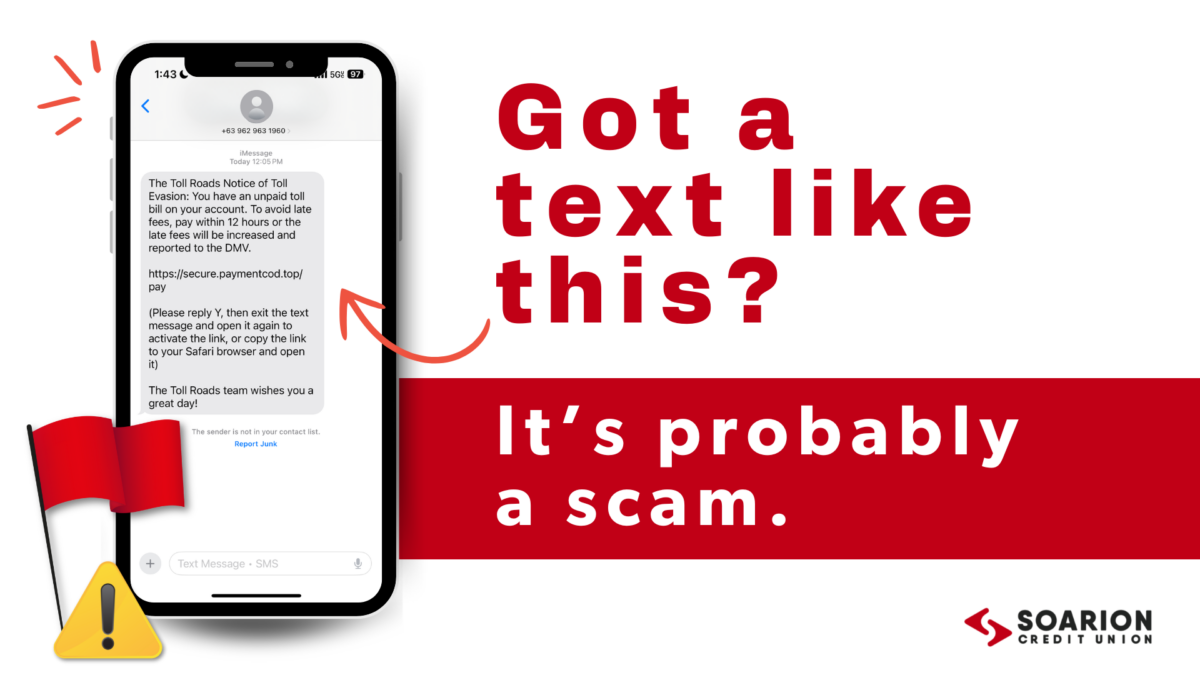
Uh-oh! Looks like a new scam is underway and it has all to do with tollways! 

Scammers are sending fake messages about Toll Road payments, asking you to click a link to avoid penalties. They’re also impersonating Soarion CU, asking for your card details and PIN.

  • If a text looks fishy, it probably is.
  • Requests for your card number, PIN, or Social Security #? Not cool.
  • Unusual links? RUN, don’t click!

What to Do if You Get a Weird Text:

  • Don’t Panic
  • Delete the Message
  • Call Soarion CU if you’ve already replied (We got your back)

Don’t click any links or share personal info. Delete the message and, if you’ve responded, contact Soarion CU for assistance.

Stay vigilant and protect your info!

If you have any questions, please reach out to us at (210) 673-5610 or drop by your nearest Financial Center.

How to Avoid Charity & Disaster Fraud

Natural disasters include all types of severe weather, which have the potential to pose a significant threat to human health and safety, property, critical infrastructure, and homeland security. Scammers are prevalent during this time and will take advantage of vulnerable individuals and exploit them for money.

According to the National Credit Union Administration (NCUA), they advise survivors and those donating to be cautious of scams around Disaster Fraud. Scammers will impersonate government employees and bogus charities in efforts to take advantage of your kindness or vulnerability. Fraudsters pretend to help with recovery but are trying to obtain your financial information.

NCUA and FEMA urge those affected by the natural disaster or those lending a helping hand to remain vigilant.

Red Flags:

Donating to Natural Disaster:

  • Use caution if any organization ask for donations in the following forms:
    • Gift Cards
    • Wire Transfers
    • Zelle or Venmo payments
    • Cash
  • Feeling pressured into donating: Organizations will not pressure you into donating or use hard-sell tactics.

Survivors:

  • No government employee or state worker should ever ask for or accept money from you when applying for disaster assistance.
  • If an individual from a government agency approaches you and they do not have proper identification, do not trust or offer any personal information and always ask to see an official I.D.
  • Take your time and do not hesitate to contact the government agencies or local law enforcement to confirm the identity and legitimacy of suspicious contacts.
  • Inspectors will never ask for your nine-digit registration number.
  • They never ask for banking information. FEMA never charges a fee for an inspection.

Fake Offers of Local or Federal Aid:

  • Do not trust someone who asks for money. Government agencies, and local law enforcement agencies will never charge applicants for disaster assistance or help in filling out applications.
  • Do not believe anyone who promises a disaster grant and asks for large cash deposits or advance payments in full.

Building Contractors:

  • Use licensed or verified local contractors. Review their references.
  • Do not pay more than half the costs of repairs in advance.
  • Demand that contractors provide detailed writing with guarantees of the job being completed.

Identity Theft:

  • If a FEMA inspector comes to your residence and you have not filed a FEMA application, your information may have been used without your knowledge. Advise the inspector of this.
  • If you receive a letter from FEMA but did not apply for assistance, please call their hotline at 800-621-3362 between 7 a.m. to 11 p.m. ET daily.

Prevention:

Donating:

  • Research before you donate:
    • Legitimate organizations will have their mission statement and what your donation will go towards on their website.
    • Legitimate organizations are listed on the National Association of State Charity Officials website.
  • Read reviews from the Better Business Bureau (BBB) to determine the charity’s validity.
  • Avoid using websites with typos, grammatical errors, or vague information. When donating it is best practice to have all pertinent information.

Survivors:

  • Report fraud or scams to FEMA investigations and Inspections Division
    • Email: stopFEMAFraud@fema.dhs.gov
    • Phone: 866-223-0814
    • Fax: 202-212-4926
    • Mail: 400 C Street SW Suite 7SW-1009 Mail Stop 3005 Washington D.C., 20472-3005
  • Contact your local law enforcement
  • File a complaint with the National Center of Disaster Fraud
  • File complaint with the Federal Trade Commission at www.ftc.gov for identity theft concerns
  • Contact Soarion Credit Union if you notice fraud on your account

Sources:

National Credit Union Administration, www.ncua.gov

FEMA, www.fema.gov

How to Avoid Brushing Scams

The season of gift giving has come and gone. We all love surprises and enjoy receiving gifts from our families and friends. Unfortunately, receiving one unexpected gift may cost you more than you realize.

How it works: An unexpected package is delivered to your residence without a return address, or the return address could be the retailer (e.g. Amazon, Walmart). Inside the package is a gift, and a QR code. The intention is to have you scan the QR code, input your personal information and leave a “positive review” of the item received. After your personal information has been provided, the scammer is able to access your phone or device.

What is at risk: Your personal and banking information.

Prevention:

  • Don’t scan the QR Code
  • Throw the item away or return it. Treat any unknown package with caution.
  • You may return the unopened package to your local post office where they will return the item on your behalf.
  • If the QR code has been scanned and information has been provided, change all usernames and passwords to your accounts. Your information may have been compromised.
  • Closely monitor your bank accounts, credit card accounts, and credit report.
  • Notify the authorities. If the item received is organic (seeds, food, plants) or an unknown substance or liquid, notify the proper authorities and follow their instructions.

Important: QR Code scams are not limited to unexpected packages delivered to homes. These scams are happening at parking meters, restaurants, concerts, and sporting events, to name a few examples. Remember to only use trusted websites, and if you scan a QR code look for misspellings or other discrepancies on the website.

For more fraud awareness resources, financial education, and simple financial solutions, visit soarion.org.

Protect Your Phone from SIM Swapping

SIM Swapping (also known as SIM hijacking) is a type of identity theft that allows a criminal to access a victim’s phone number and personal information. Criminals trick mobile phone carriers into transferring a victim’s account to a new SIM card. The criminal can intercept calls and text messages, including those containing two-factor authentication (2FA) codes.

In 2023, the FBI reported victims have lost more than $48 Million dollars to SIM Swapping. As of 2024, the FBI is aware of 800 cases of SIM Swapping.

What’s at risk: Any account tied to the victim’s phone number such as email, banking, and social media.

Signs: Your phone suddenly stops working, loses connection, cannot make calls, cannot send or receive text messages or you receive notifications about your service switching to another provider

Prevention:

  • Use strong and unique passwords
  • Contact phone carrier about setting up a PIN which will be required for any account changes
  • Use facial recognition while using the mobile app
  • Be alert for phishing attempts by way of call, email, or text message asking for personal information
  • Be mindful of the information shared online such as Date of Birth, Driver’s License, or personal information that could be used as a security question

Don’t Become a Money Mule

Money Mules are people who, at someone else’s direction, receive and move money obtained from victims of fraud.

How can you protect yourself and ensure you don’t facilitate one of these scams?

Warning signs:

  • Someone you met online asks you to accept money and send it to someone else.
  • Someone asks you to open a bank or cryptocurrency account.
  • Someone asks you to receive packages for them.

Here are a few things to keep in mind:

  • Don’t agree to receive or send money or packages for people you don’t know or haven’t met in person.
  • Don’t send money to an online love interest, even if the money was sent to you first.
  • Don’t pay to collect a prize or send someone money out of your “winnings.”
  • Never give your financial information to someone you don’t know and trust.

If you believe that you are participating in a money mule scam, report the suspicious activity to the FBI’s Internet Compliant Center (IC3) at ic3.gov or contact your local FBI field office.

Beware of AI Scams

Artificial Intelligence scams: What are they? And how can you protect yourself from them?

As technology is changing, so are the ways fraudsters deploy scams.

Artificial Intelligence (AI) scams are currently on the rise. This scam happens when a fraudster uses AI to clone the voice of a loved one or loved ones, then calls using the voice, pretending to be desperate for money to get out of trouble or danger. This call is usually followed by a second call from the fraudster who then claims to be a public defender, law enforcement agent, or an attorney for your loved one. They request money to help your loved one and ask you to send the funds through wire transfers, gift cards, payment apps, or cryptocurrency.

Meant to play on emotion, these calls can be very convincing. If you should receive a call like this, try not to panic, don’t immediately believe the claim. Instead, ask questions that only your real loved one would know or hang up and call your loved one at a number you know to be theirs. If you can’t reach them, try other measures to contact them before assuming the call is real. We also encourage you to take precautions on what you share on social media. Fraudsters use this information to learn about you and your loved ones.

If you have been a victim of a scam or spot a scam, please call Soarion Credit Union or report it to the Federal Trade Commission (FTC).

• Go online: www.ftc.gov

• Call the FTC at 1-877-FTC-Help